
English 


Views: 0 Author: Site Editor Publish Time: 2026-11-09 Origin: Site


In industrial meat processing, inconsistent patty weight leads to costly product giveaway. Irregular shapes simultaneously cause uneven cooking and intense customer dissatisfaction. These issues harm profitability and damage brand reputation in a highly competitive market. You must balance raw material science and mechanical precision to stay competitive. Achieving consistency at scale requires understanding the physical variables hiding in your meat block. You must also utilize the right industrial forming equipment to mitigate those operational risks.
In this article, you will discover exactly how temperature, fat ratios, and texture manipulate shape retention. We will explore how advanced molding systems combat product giveaway through exact portion control. Finally, you will leave with actionable strategies to stabilize your forming lines, reduce physical waste, and maximize your overall production yield.
Raw material temperature and fat-to-lean ratios directly impact mold filling and post-forming shrinkage.
The forming pressure mechanism used by your equipment determines density, fiber preservation, and weight accuracy.
Switching to optimized mold plates and automated knock-out systems drastically reduces edge tearing and shape deformation.
Investing in modern forming technology minimizes product giveaway, improving overall yield and protecting profit margins.
Achieving the perfect patty starts long before the meat enters the hopper. The physical state of your raw materials dictates how well they flow into mold cavities. If you ignore these variables, even the best equipment will produce inconsistent results.
Temperature control acts as the foundation of successful meat forming. Processing meat that is too cold creates a brittle, rigid structure. This stiffness prevents the meat from flowing smoothly into the corners of the mold cavity. Incomplete mold filling directly causes underweight patties and jagged edges.
Conversely, processing meat that is too warm introduces severe operational risks. Warm temperatures cause fat smearing during the mixing and pumping stages. Smeared fat acts like an adhesive. It sticks aggressively to machine components, mold plates, and knock-out cups. This sticking leads to surface tearing and rapid shape deformation upon release. Industry best practices typically recommend maintaining the meat block between 28°F and 32°F (-2°C to 0°C) for optimal flow and clean release.
The fat percentage in your recipe fundamentally alters the viscosity of the mix. High-fat blends flow more easily under pressure but carry a higher risk of smearing. Leaner blends resist flow and require higher forming pressures to fill the mold completely.
You must also consider the relationship between mechanical pressure and downstream cooking loss. Applying excessive pressure to a high-fat blend forces fat out of the protein matrix. When consumers cook these patties, the destabilized fat renders out rapidly. This rapid rendering causes severe shrinkage and a dry mouthfeel. Balancing your fat-to-lean ratio with appropriate forming pressure ensures better moisture retention and minimal shrinkage.
The method used to reduce your meat block significantly impacts the final bite. Different reduction methods create distinct textures:
Ground Meat: Retains distinct muscle fibers. It provides a traditional, chewy bite preferred in premium burgers.
Chopped Meat: Offers a slightly more cohesive texture while preserving visible fat and lean definition.
Bowl-Chopped Meat: Creates an emulsified, paste-like texture. This is common in value-tier products or chicken nuggets.
Aggressive auger feeding inside the forming hopper can destroy delicate muscle fibers. Overworking the meat protein transforms a tender bite into a dense, "rubbery" texture. Protecting fiber orientation requires gentle handling from the grinder all the way through the forming stroke.
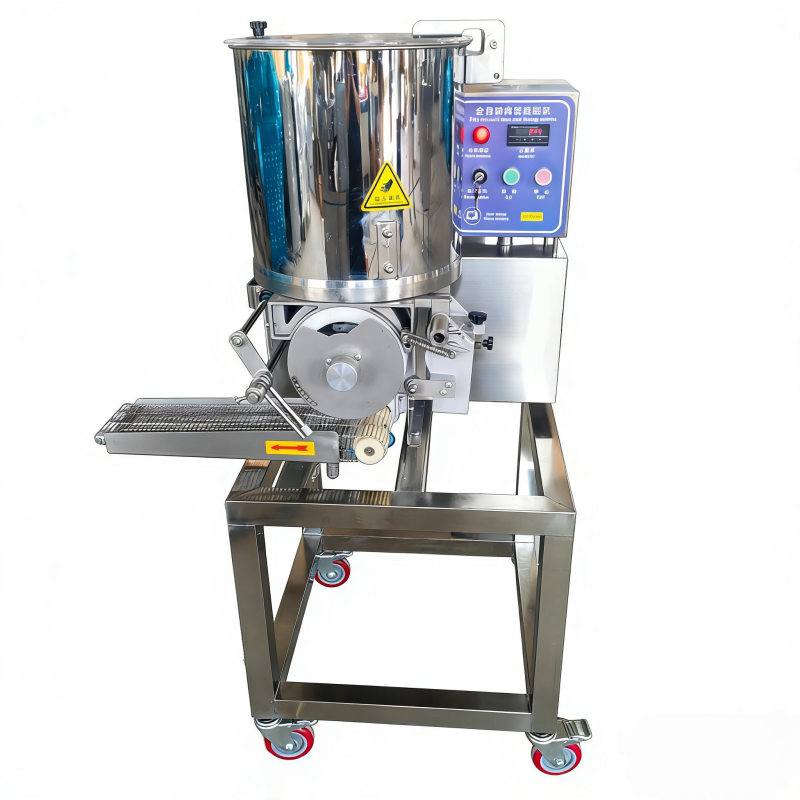
Modern production facilities rely on mechanical precision to eliminate human error. A high-quality Meat Patty Forming Machine uses controlled pressure and precise volumetric filling to ensure every patty meets exact specifications.
Filling a mold cavity requires displacing air and packing the meat tightly. Equipment manufacturers generally use two main mechanisms to achieve this:
Hydraulic Systems: These systems apply constant pressure regardless of the meat block's viscosity. They excel at maintaining identical density across every single stroke.
Mechanical Cam Systems: These systems deliver a constant volume per stroke. They are highly reliable but can sometimes struggle if the meat block density fluctuates wildly.
Consistent pressure ensures identical density. If density varies, patties of the exact same size will weigh differently. Managing this pressure is the secret to strict portion control.
Product giveaway silently destroys profit margins. Imagine over-portioning a standard burger by just three grams. If your facility produces 50,000 patties per shift, you lose 150 kilograms of meat daily. Over a year, this financial impact becomes staggering.
Advanced forming machines utilize servo-driven fill systems to stop this leakage. Servo motors maintain exact volumetric portioning regardless of fluctuating hopper levels. They adjust the fill stroke dynamically, ensuring every cavity receives the precise amount of meat required. This technology locks in weight accuracy and protects your bottom line.
Forming the patty is only half the battle. Releasing it cleanly from the mold is equally critical. A poorly designed knock-out process causes "cupping," where the center of the patty bows outward. It also causes severe edge tearing.
Engineers combat these issues using specialized release mechanisms. Wire scrapers clean the top and bottom of the mold plate during the stroke. Air assist systems inject a tiny burst of compressed air to break the vacuum seal between the meat and the mold. Specific knock-out cup designs match the patty geometry perfectly. These innovations work together to push the product onto the belt while maintaining flawless geometric integrity.
Your choice of tooling directly affects production flexibility and product quality. The mold plate serves as the physical boundary for your product. Selecting the right plate design prevents surface voids and weight inconsistencies.
Standard fixed plates remain the industry workhorse. They feature precision-machined cavities designed for a single specific weight and shape. A critical feature of these plates is the inclusion of breather holes. Breather holes allow trapped air to escape as meat fills the cavity. Without them, air pockets form. These pockets create surface voids and cause severe weight variations.
Material selection also matters. Food-grade plastics, like UHMW polyethylene, reduce friction and prevent smearing. Alloy plates offer extreme durability but may require different lubrication strategies depending on the fat content of your meat block.
Facilities producing multiple SKUs often struggle with constant tooling changeovers. Every minute spent swapping fixed plates is a minute of lost production. Investing in Adjustable Patty Molds solves this bottleneck.
These molds feature internal mechanisms to adjust the cavity depth on the fly. You can switch from a 4-ounce patty to a 6-ounce patty without removing the plate. When evaluating the ROI of adjustable molds, you must weigh flexibility against density control. Adjustable molds offer incredible weight adjustment speed. However, they can sometimes introduce slight density variances compared to single-piece fixed plates.
Comparison of Mold Plate Technologies
Feature | Standard Fixed Plates | Adjustable Molds |
|---|---|---|
Weight Accuracy | Extremely high (fixed volume) | High (adjustable volume) |
Changeover Time | High (requires physical swap) | Low (dial-in adjustment) |
SKU Flexibility | Single weight per plate | Multiple weights per plate |
Air Venting | Simple, direct breather holes | Complex internal venting |
Consumer demand for "homestyle" or custom-shaped patties continues to rise. Ovals, natural-edge geometries, and custom cut-outs challenge traditional forming dynamics. Complex geometries change how meat flows into the corners of the mold. They require specialized cavity venting to prevent air traps. If you plan to produce custom shapes, you must work closely with your tooling provider to map the flow dynamics accurately.
Purchasing new equipment requires matching machine capabilities with your specific product goals. You must look beyond raw speed. Evaluate how the machine interacts with the meat and how it fits into your broader facility ecosystem.
The best equipment moves meat gently. Assess machines based on their ability to portion with minimal sheer and friction. Traditional forming methods sometimes compress meat into a dense, industrialized puck. This ruins the eating experience.
A modern Hamburger Patty Former utilizes low-pressure filling systems. These systems mimic a "hand-made" texture. They preserve fiber orientation and allow for natural shrinkage during cooking. This gentle handling ensures a tender, juicy bite that consumers associate with premium restaurant quality.
Do not buy a machine simply because it boasts the highest strokes-per-minute (SPM). High speed is useless if your downstream equipment cannot handle the volume. You must align the former's SPM with your freezing and packaging capacities. If the former outpaces the spiral freezer, patties will back up, warm up, and deform on the belt. Balance throughput carefully against your facility's actual footprint and downstream constraints.
Food safety compliance is non-negotiable. Evaluate forming machines based on their hygienic design. Look for IP69K ratings, which certify the machine can withstand high-pressure, high-temperature washdowns. Toolless disassembly is another crucial feature. Operators should easily access the hopper, augers, and forming drive without wrenches. Eliminating hidden harborage points prevents bacterial growth and drastically reduces daily sanitation times.
Installing new equipment disrupts established workflows. Anticipating implementation risks helps you navigate the commissioning phase without suffering massive yield losses.
Every meat blend behaves differently under pressure. Beef flows differently than poultry, and plant-based mixtures present entirely new viscosity challenges. When you install a new Burger Patty Machine, you must undergo a strict calibration phase.
You will need to dial in exact pressure and fill settings for each specific recipe. Expect some initial yield loss during this trial-and-error period. Document every setting meticulously. Once you find the optimal parameters, save them into the machine's control panel to ensure repeatability across different operator shifts.
The most advanced machine will fail if assembled incorrectly. You must prioritize operator training. Misaligned mold plates or improperly seated knock-out cups cause immediate shape defects. Teach your staff the mechanical "why" behind the assembly process. When operators understand how the knock-out sequence works, they can troubleshoot minor sticking issues before they escalate into massive product waste.
A forming machine does not operate in isolation. It relies on a steady supply of raw material. Ensure your upstream grinder and mixer feed the former at a consistent rate. Hopper starvation introduces air into the fill system, causing severe weight drops.
Downstream integration is equally vital. You must align the outfeed belt speed with flatteners, batter applicators, or spiral freezers. If the outfeed belt runs too fast, it stretches the patties into ovals. If it runs too slow, patties bunch up and overlap. Perfect synchronization prevents post-forming deformation.
Patty weight and shape are dictated by a complex combination of temperature control, recipe formulation, and mechanical precision. Ignoring any of these variables leads to product giveaway, shape deformation, and lost profits. By maintaining strict temperature parameters and protecting meat fiber orientation, you set the foundation for a perfect product.
We recommend prioritizing equipment that offers gentle portioning and high volumetric accuracy. Advanced servo-driven systems and optimized mold plates protect both your product quality and your profit margins. Do not leave your production yields to chance.
As a next step, request a live product test with an OEM. Use your specific meat blend during the trial. This hands-on validation will prove the machine's weight accuracy and shape retention capabilities before you make a final purchase decision.
A: Uneven shrinkage is typically caused by inconsistent fat distribution, excessive forming pressure that damages meat fibers, or improper meat temperature during the forming process. High pressure forces fat out of the protein matrix, causing rapid rendering and severe shrinkage when heat is applied.
A: Ensure the meat block is kept at the optimal temperature (usually near freezing). Verify that the knock-out mechanism is functioning correctly. Check the mold plate for wear or scoring. Warm meat causes fat smearing, which acts like an adhesive against the tooling.
A: Yes, but it requires a machine with adjustable fill pressures and potentially different mold plates. Plant-based mixtures have vastly different viscosities and sticking properties than animal proteins. You must calibrate the machine specifically for the unique flow dynamics of plant-based ingredients.
A: High-quality forming equipment should maintain a weight variance of less than 1% to 1.5% per patty. Maintaining this tight tolerance minimizes costly product giveaway and ensures consistent cooking times for the end consumer.


