
English 


Views: 0 Author: Site Editor Publish Time: 2026-11-08 Origin: Site


Achieving perfect flavor and texture in commercial meat processing requires absolute precision. A high-performance Brine Injection Machine plays a critical role in maintaining consistent product quality, optimal yield, and strict food safety standards. It delivers marinades directly into muscle tissues to enhance moisture retention.
However, processors frequently encounter "uneven injection." We define this distribution variance as a critical failure point. It creates localized dry spots or salty pockets inside the cut. This inconsistency compromises flavor profiles, ruins texture, and ultimately hurts your profitability. Customers expect uniform taste in every bite.
You need reliable methods to identify and solve these distribution errors immediately. Our goal is to provide a comprehensive technical framework for operators. You will learn how to diagnose injection inconsistencies. We will help you mitigate mechanical failures, optimize machine settings, and elevate your overall processing efficiency.
Uneven injection is rarely a "single cause" issue; it typically results from a misalignment between needle density, pump pressure, and product resistance.
Operational maintenance—specifically needle integrity and filter hygiene—is the most frequent contributor to distribution variance.
Modern automatic brine injectors require calibrated synchronization between belt speed and stroke frequency to ensure uniform uptake.
Effective troubleshooting starts with assessing the "injection profile" against specific muscle morphology and fat content.
Understanding uneven brine distribution requires looking closely at your equipment mechanics. Flaws in the delivery system directly translate to flaws in the meat. We must examine the physical pathways the marinade takes.
Marinades often contain spices, suspended particles, or thick functional ingredients. These elements can easily clog narrow pathways. When a Multi-Needle Meat Injector experiences partial or total clogs, it creates distinct "blind spots" in the product. The fluid simply cannot reach the target tissue.
Furthermore, bent or damaged needles disrupt the carefully designed spray pattern. A bent needle might inject fluid sideways into an adjacent needle's path. This leaves one area completely dry while over-saturating another. You must inspect these components daily.
Injection heads rely on complex spring-loaded assemblies. These springs absorb shock when needles hit bones or dense connective tissue. Over time, constant compression causes metal fatigue. The springs lose their elasticity.
When spring degradation occurs, you lose consistent penetration force. Some needles will pierce deeply, while others retract prematurely. This mechanical wear leads to shallow injection depths across the meat block. You will notice dry centers in thicker muscle cuts.
Consistent fluid pressure is the heartbeat of any processing line. Pump cavitation poses a massive threat to distribution uniformity. Cavitation happens when air bubbles form and collapse inside the pump chamber. It disrupts the steady flow of liquid.
Air ingress in the delivery lines causes similar problems. The system pumps air pockets instead of fluid into the meat. This leads to wildly inconsistent discharge volumes across the entire needle bank. One side of the manifold might deliver full volume, while the other side sputters.
Even perfect pumps and clean needles will fail if the meat moves. Improper conveyor belt tension allows cuts to slip during the stroke cycle. Lack of adequate hold-down plate pressure lets the meat shift upward as needles retract.
This shifting causes uneven needle alignment during subsequent strokes. The machine might strike the same area twice while missing another section entirely. Proper stabilization ensures the product remains perfectly stationary during the critical penetration phase.
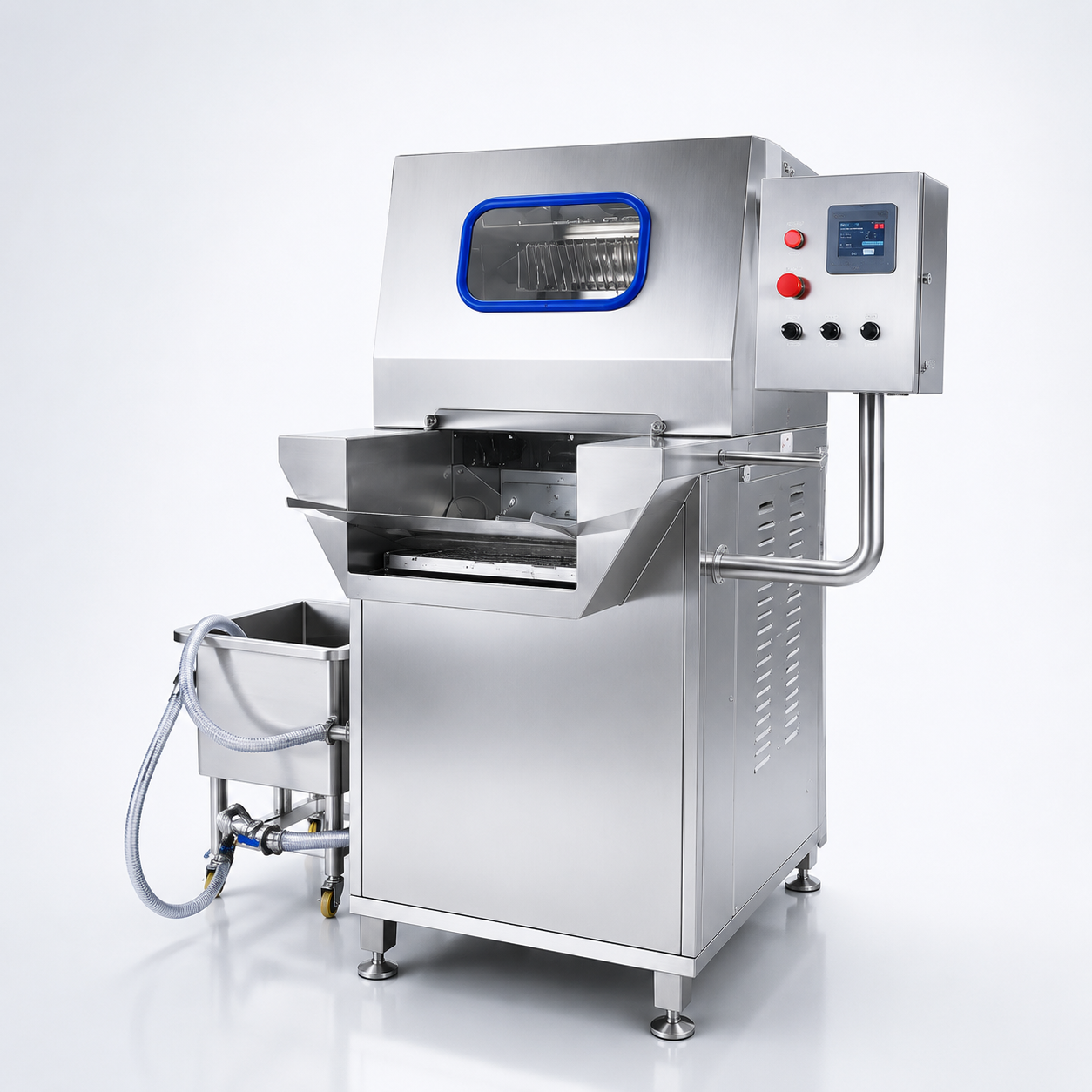
Machine configuration dictates success long before the first piece of meat enters the line. Processors must align their equipment specifications with their raw materials. Let us explore the primary criteria for achieving perfect uniformity.
You cannot use a universal needle for every product. Needle density and pattern design must match the specific cut size. They must also account for species-specific fiber structures. Poultry requires different handling than dense beef briskets.
Consider the difference between standard and high-density manifolds. Thicker, tighter muscle fibers require closer needle spacing for adequate dispersion. Using widely spaced needles on dense pork loins will inevitably leave unmarinated gaps between injection sites.
Configuration Factor | Primary Function | Impact on Uniformity |
|---|---|---|
Needle Diameter | Determines fluid volume per stroke. | Large diameters risk pooling; small diameters risk blockages. |
Manifold Density | Controls the distance between injection sites. | High density ensures overlap in dense muscle fibers. |
Hold-Down Plate | Secures meat during needle retraction. | Prevents product shifting and double-striking. |
Pump Capacity | Maintains manifold pressure. | Ensures equal fluid distribution to outer needles. |
Marinade physics matter. Brine temperature and salt concentration drastically impact fluid flow dynamics. Cold, highly viscous solutions travel slower through the delivery lines. They put immense strain on the injector pump.
If the fluid is too thick, outer needles on the manifold may starve. The center needles take the path of least resistance, delivering too much fluid. You must maintain consistent batch temperatures to ensure stable viscosity throughout the production run.
Production demands often tempt operators to speed up the line. However, pushing a Meat Marinating Equipment unit beyond its rated capacity inevitably degrades distribution precision. Belt speeds outpace the mechanical stroke rate.
When this happens, the machine creates elongated needle tracks rather than clean punctures. The fluid tears the muscle tissue instead of dispersing gently. You must respect the designed throughput limits to maintain product integrity.
Modern programmable logic controllers (PLCs) represent a massive leap forward. They minimize human error in pressure and speed calibration. Operators can save specific recipes for different meat cuts.
These automated parameters lock in the exact pump pressure, stroke height, and belt advance. Relying on manual dials often leads to slight variations between shifts. Automation guarantees the machine treats the thousandth piece of meat exactly like the first.
Brilliant engineering cannot overcome poor daily habits. The reality on the processing floor is often harsh. Preventive maintenance serves as your strongest defense against unpredictable product quality.
Rigorous cleaning routines are non-negotiable. Preventive needle cleaning removes protein buildup before it calcifies inside the shaft. You must also inspect all rubber gaskets and manifold seals daily.
Failing to replace worn gaskets causes microscopic pressure leaks. These leaks reduce force to specific needle zones. They are the primary reason for "streaking" or localized under-injection. A strict daily protocol catches these cheap components before they ruin expensive meat.
Your machine operates in a closed loop. It recycles excess marinade falling from the meat block. This runoff carries fat particles, meat fibers, and coagulated proteins back into the reservoir.
There is a direct link between brine purity and equipment longevity. Effective rotary and inline filtration systems remove this sediment. If filters fail or overflow, debris enters the main pump. This immediately clogs the needle head components, halting uniform distribution.
Floor operators sometimes try to solve uneven distribution by simply cranking up the pump pressure. This "quick fix" creates more problems than it solves. It forces liquid violently into the meat, tearing the delicate fiber structure.
Modifying injector settings without accounting for raw material variability is dangerous. For example, a drop in meat temperature makes the fat firmer. Increasing pressure against firm fat causes the liquid to bounce back. You must adjust parameters holistically, respecting the meat's physical state.
When uneven injection occurs, guessing wastes time and ruins product. You need a systematic approach to isolate the root cause. Follow these four diagnostic steps to restore uniformity.
You must know exactly what failure looks like. Differentiating between various symptoms tells you where to look first. Conduct a thorough visual audit using the following process:
Slice the meat cross-wise immediately after injection.
Examine the surface for excessive pooling, which indicates torn fibers or excessive pressure.
Look deep into the tissue center for dry distribution gaps, which point to insufficient stroke depth.
Check the bottom of the cut for blowout marks, suggesting the needles hit the conveyor belt.
This physical evidence narrows down your troubleshooting focus.
Sometimes the problem is invisible to the naked eye. You must map the exact paths the liquid takes. The most effective method is the colored water test.
Run a test batch using water dyed with food coloring. Pass white paper or a uniform synthetic block through the machine. The dye will clearly map every single needle path. You will instantly identify inactive, misaligned, or partially blocked needles based on the spray pattern.
If the pattern is perfect but the yield is low, suspect the delivery system. You need to verify pump output consistency during active cycles. Do not rely solely on the digital HMI screen.
Attach calibrated analog pressure gauges directly to the manifold intake. Watch the needle during the downward stroke. If the pressure drops severely during injection, your pump is struggling. Look for clogged intake filters, air leaks in the suction line, or a failing pump impeller.
Finally, examine what you are feeding into the machine. Sometimes the equipment works perfectly, but the raw material is flawed. Raw material variance often overpowers the machine’s capabilities.
Analyze your upstream processes. Erratic carcass trimming leaves unpredictable fat caps. Inconsistent chilling creates varying core temperatures. A machine calibrated for soft, 40°F muscle will fail to inject properly into stiff, 32°F partially frozen meat. Control your inputs to stabilize your outputs.
Achieving consistent brine distribution demands a holistic approach to processing. It requires a delicate balance of rigorous preventive maintenance, proper machine calibration, and a deep understanding of meat morphology. You cannot ignore one aspect without compromising the others.
We encourage processors to view injection performance not just as a mechanical task, but as a core KPI for overall yield management. When your distribution is uniform, your slicing yields improve, your purge decreases, and your customers remain loyal. It is the foundation of a profitable product line.
Finally, do not hesitate to seek outside expertise. The complexity of modern Automatic Brine Injectors requires specialized knowledge. We strongly recommend scheduling periodic professional technical assessments. Expert technicians can identify microscopic wear and software misalignments before they trigger catastrophic yield losses.
A: Replacement schedules depend entirely on wear-and-tear cycles, usage volume, and maintenance rigor. High-volume plants processing bone-in products may need needle replacements every three to six months. Facilities running boneless cuts might stretch this to a year. You should inspect needles daily; replace any bent or dull needles immediately to prevent localized distribution failures.
A: Yes, meat temperature drastically impacts uniformity. The relationship between muscle firmness and needle penetration is direct. Colder meat has firmer fat and tighter muscle fibers, which resist fluid dispersion and force liquid back up the needle track. Warmer meat accepts fluid better but risks bacterial growth. Maintain consistent tempering protocols.
A: Brine pockets usually result from mismatched injector pressure settings versus muscle density. If pump pressure is too high for a delicate cut, the fluid violently tears the internal muscle fibers, creating a cavity where liquid pools. Lowering the pressure and using a higher-density needle manifold usually resolves this issue.
A: Absolutely. There is a precise relationship between belt speed, stroke rate, and needle pitch. If the belt moves too fast, the distance between injection sites increases, leaving unmarinated dry zones. If it moves too slowly, the machine over-injects the same area. Synchronization is vital for overlapping dispersion zones.


