
English 


Views: 0 Author: Site Editor Publish Time: 2026-11-11 Origin: Site


Modern food processing plants operate under relentless production schedules where physical contamination presents an ongoing operational danger. A broken screen wire, a loose bolt, or an eroded blade can enter the processing line without warning. When these foreign bodies pass through undetected, they cause severe line downtime, break downstream machinery, and create grave hazards for consumers. Regulatory frameworks such as FSMA, GFSI, BRCGS, and SQF demand rigorous prevention methods to stop adulterated items before distribution. Installing an industrial Food Metal Detector provides a crucial line of defense across primary packaging and bulk inspection stages. This guide examines the physical contaminants these systems capture, details their scientific boundaries, and outlines how engineering teams configure them for dependable foreign body prevention.
Detects three distinct metal classes: Ferrous metals (iron, carbon steel), non-ferrous metals (copper, brass, aluminum), and non-magnetic stainless steels (304, 316), each presenting varying electromagnetic responses.
Limited by non-metallic materials: Standard units cannot identify bone, glass, high-density plastics, stones, or ceramics without secondary X-ray inspection.
Product effect governs sensitivity: High-moisture, salty, or acidic foods create conductive signals that require digital multi-frequency filtering to avoid false rejections.
End-to-end line integration matters: Effective detection depends on matching aperture dimensions, conveyor belt speed, and automatic reject systems to specific throughput requirements.
Compliance mandates continuous verification: Regular QA verification routines using certified test wands are mandatory to prove audit readiness and system reliability.
Balanced-coil inspection systems function by projecting high-frequency electromagnetic fields through a central aperture. When an electrically conductive or magnetically permeable particle crosses this field, it alters the balanced voltage across the receiver coils. How readily a particle triggers this alarm depends on its underlying physical traits.
Industrial inspection heads classify target metals into three primary categories based on magnetic permeability and electrical conductivity:
Ferrous metals (iron, mild steel, carbon steel): These materials display high magnetic permeability and high electrical conductivity. They distort electromagnetic fields readily. A standard coil system catches tiny ferrous fragments down to sub-millimeter diameters (often under 1.0 mm), making them the simplest contaminants to isolate.
Non-ferrous metals (copper, brass, aluminum, lead): These alloys are non-magnetic, but they possess outstanding electrical conductivity. When they cross the aperture, high-frequency eddy currents form across their surfaces. These currents create secondary fields, which trigger the receiver coils at low detection thresholds.
Stainless steel (series 300 and 400): Detectability changes dramatically across stainless grades. Cutlery-grade 400-series stainless retains magnetic properties, so equipment catches it almost as easily as mild steel. Conversely, austenitic 304 and 316 grades—widely used across sanitary food machinery—are virtually non-magnetic and conduct electricity poorly. Consequently, catching a 316 stainless sphere often demands a particle 1.5 to 2.0 times larger in diameter than a ferrous equivalent.
Contaminant Detectability and Material Attributes
Contaminant Classification | Magnetic Permeability | Electrical Conductivity | Relative Detection Difficulty | Common Source Examples |
|---|---|---|---|---|
Ferrous (Carbon Steel, Iron) | Very High | High | Low (Easiest to catch) | Chain links, bolts, drive teeth, rust flakes |
Non-Ferrous (Brass, Aluminum, Copper) | None (Non-magnetic) | Extremely High | Moderate | Solenoid parts, copper wiring, brass fittings |
Stainless Steel (Series 400) | Moderate to High | Moderate | Low to Moderate | Mixer blades, packaging blades, wear plates |
Stainless Steel (Series 304 / 316) | Extremely Low (Non-magnetic) | Low | High (Hardest to catch) | Sanitary pipes, hoppers, pump impellers, welds |
Non-Metallic Inclusions (Bone, Glass, Stone) | Zero | Zero (Insulative) | Undetectable by coil systems | Field debris, processing bones, container chips |
Electromagnetic inspection provides excellent protection against tramp metals, but it cannot resolve non-conductive hazards. Plant managers must understand these blind spots to avoid false assumptions about food safety coverage.
Standard coils cannot identify dense stones, field wood, insect matter, or rigid plastics. Broken glass shards, calcified poultry bones, and beef cartilage are transparent to electromagnetic fields. If an operator slices a silicone gasket, the detector ignores the fragments unless maintenance uses metal-detectable elastomer compounds impregnated with minute metallic powders.
Contaminant shape introduces another variable known as the orientation effect. A uniform metal sphere produces identical signal amplitudes regardless of how it passes through the aperture. Irregular contaminants, such as thin wire slivers or flat sheet shavings, behave differently. If a wire passes through parallel to the coil axis, it presents a minute cross-section and generates a weak signal. If that same wire enters end-on or perpendicular to the field, its reactive signature spikes significantly.
Packaging materials also introduce distinct constraints. Products sealed inside traditional aluminum foil pouches block balanced coils by overwhelming them with conductive signals. You must either inspect these goods prior to packaging or deploy specialized magnetic field inspection or X-ray machinery downstream.
Inspecting dry, inert foods like dry pasta or white sugar is straightforward. These goods create virtually no background electrical disturbances. However, wet, salty, or acidic products produce conductive signals that mimic metal contaminants, confusing older analog sensors.
Moisture and dissolved electrolytes allow electrical current to travel across food products. When a fresh poultry breast, block of salted cheddar, or tub of tomato sauce enters the coil opening, it functions like an imperfect conductor. Engineers refer to this phenomenon as product effect.
High-fat foods or deep-frozen blocks exhibit little conductivity, yet they alter dielectric permittivity readings. Furthermore, temperature variations disrupt line calibration. A thawed carton creates a massive conductive signature compared to its frozen equivalent. If your equipment relies on basic signal thresholds, this background noise triggers frequent false alarms. High false reject rates (FRR) cause severe losses. Operators waste good food, stop lines to clear jams, and waste labor re-inspecting discarded items.
Modern quality assurance depends on a high-performance Digital Metal Detector to suppress these reactive background signals. Modern systems process raw inputs using advanced software algorithms instead of basic analog voltage comparators.
Digital Signal Processing (DSP) separates complex signals into reactive and resistive components. By plotting these variables on a phase angle chart, the processor distinguishes between the conductive signature of warm salted meat and the signature of a stainless steel shaving. Digital phase tracking continually evaluates shifting product attributes. If a pallet of product arrives several degrees warmer than normal, the software adjusts its phase angle boundary to prevent false triggers.
Simultaneous multi-frequency operation represents a major leap forward over traditional single-frequency units:
Single-frequency coils force technicians to choose one fixed operating frequency. A high frequency catches tiny stainless particles but magnifies wet product effect. A low frequency ignores product moisture but misses small stainless splinters.
Simultaneous multi-frequency architectures run multiple frequencies through the coil simultaneously. The internal processor compares field disturbances across high and low bands concurrently.
The software subtracts the product effect signature in real time. This noise-canceling process reveals tiny non-ferrous and stainless steel fragments concealed within conductive products.
Determining where to place inspection machinery requires an analysis of Hazard Analysis Critical Control Point (HACCP) principles. Proper placement protects processing machinery and guarantees consumer safety.
Food manufacturers generally establish inspection points across two operational stages:
Bulk and raw material intake (Upstream CCP): Technicians position gravity-fed, pipeline, or bulk belt units right after raw ingredient receiving or batch grinding. Inspecting ingredients early catches rogue fasteners, field wire, and stray processing tools before they enter downstream equipment. This step saves high-speed slicers, bowl choppers, and extruders from expensive mechanical breakdowns.
Post-packaging inspection (Downstream CCP): Positioning equipment after sealing operations creates a conclusive safety gate. This final check validates that no mechanical wear from fillers, cappers, or baggers contaminated the finished food. Inspecting sealed containers ensures no foreign bodies enter the product stream before distribution.
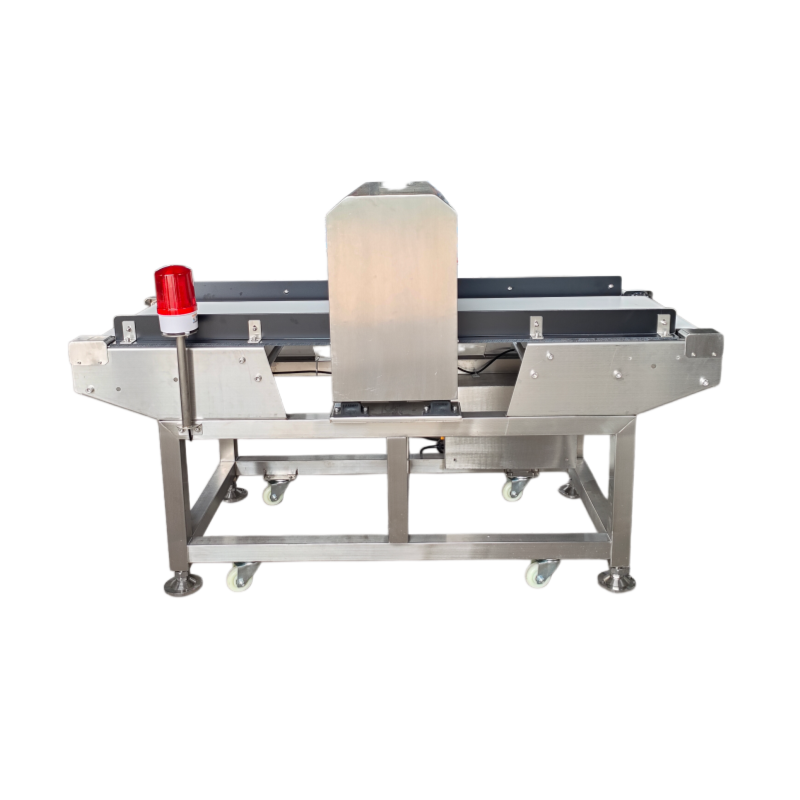
Successful physical deployment depends on meticulous conveyor design and mechanical isolation. A poorly installed Conveyor Metal Detector will suffer from false triggers caused by vibration and electrical interference.
Aperture sizing dictates base sensitivity. Electromagnetic field strength dissipates sharply toward the center of the opening. You should always select the smallest aperture that allows your packaged product to pass with adequate physical clearance. Oversized heads reduce field density, forcing the unit to run at high gain settings that invite operational instability.
Conveyor belt selection is equally critical. Belts must use non-metallic, anti-static materials like food-grade polyurethane. Mechanical belt splices made of metal fasteners are unusable; engineers must specify vulcanized, finger-spliced joints. Electrostatic charges that accumulate on running belts create sudden voltage discharges that mimic tramp metals.
Engineers must also maintain a dedicated Metal-Free Zone (MFZ) around the detector head. Stationary plant frames, metal rollers, and structural supports must remain outside this exclusion envelope. Moving metals, like ungrounded gravity rollers or swinging diverter gates, demand even wider clearances—often two to three times the aperture height. Failure to isolate the coil from structural motor vibrations causes erratic baseline drift and ghost detections.
Detecting a metallic particle achieves nothing if the line cannot reliably remove the contaminated unit. An automated detection station requires a dependable mechanical reject device integrated directly into line controls.
The ideal rejection mechanism depends on container geometry, weight, product fragility, and conveyor velocity:
High-speed air blast: Solenoid-actuated air nozzles shoot a concentrated jet of compressed air to knock bad units into a bin. This design excels on lightweight items under 200 grams, including snack pouches, wrapped confections, and dry seasonings operating above 120 units per minute.
Pneumatic pusher rams: A heavy-duty piston stroke drives contaminated packages across the belt at right angles into a containment chute. Pushers work well for rigid cardboard cartons, bulk tubs, and wet meat trays where product mass requires decisive mechanical force.
Retracting nose belts and drop flaps: The end of the conveyor collapses downward or pulls back axially, allowing the contaminated item to fall onto an under-belt bin. This approach protects delicate, unbaked goods, fresh pastry dough, or unwrapped protein cuts from cosmetic damage.
Choosing an integrated Automatic Reject System ensures that contaminated units leave the belt without interrupting upstream packaging flows.
Modern quality standards like BRCGS and IFS prohibit basic, open catch pans. Modern CCP installations require enclosed, audit-compliant reject stations equipped with active validation hardware.
Photoelectric confirmation sensors must verify that rejected containers successfully leave the primary line and cross into the reject bin. If a pneumatic cylinder fails to cycle, or if an air line loses pressure, the system halts the line immediately. Bin-full proximity sensors warn operators before accumulating packages block the discharge chute.
Containment bins require physical locks keyed exclusively for QA technicians. This precaution prevents line operators from retrieving rejected packages and returning them to the packaging stream without documented root-cause investigations. Onboard digital microcontrollers record every event with a precise timestamp, cataloging the reject reason, batch code, and signal amplitude for regulatory tracking.
Selecting factory inspection equipment requires a balanced analysis of mechanical design, washdown protection, and daily verification procedures.
Quality and maintenance teams should review equipment capabilities against clear environmental and physical operating conditions:
Mechanical ingress protection: Dry processing lines for cereals and snacks perform well with IP66 mild washdown enclosures. Protein slaughter facilities, dairy plants, and ready-to-eat packaging rooms require IP69K-rated housings. These units withstand daily high-pressure caustic sanitation up to 80°C and 100 bar without internal seal degradation.
Hygienic frame fabrication: Look for open-frame conveyors fabricated from seamless, laser-welded 304 or 316 stainless steel. Avoid square hollow structural tubing that traps pooled liquids. Sloped horizontal surfaces promote water drainage and eliminate bacterial harbor points.
Realistic sensitivity thresholds: Target realistic, repeatable spherical detection sizes instead of chasing theoretical sensitivity limits. Setting equipment gains near maximum limits makes the system vulnerable to false rejections from slight mechanical shocks.
Installing quality equipment fulfills only part of your safety obligations; plants must continually verify operational readiness to satisfy FSMA and GFSI auditors.
Quality teams must test balanced coils using certified test wands containing calibrated metal spheres (Ferrous, Non-Ferrous, and Stainless Steel 316). Operators must run these wands through three separate aperture zones: the leading edge, the center point, and the trailing edge. The center point represents the weakest electromagnetic field zone; passing tests here guarantees uniform detection throughout the opening.
Plant SOPs should mandate performance tests across strict operational intervals:
At the start of every production shift.
Following product changeovers or mechanical belt adjustments.
Directly after line stoppages, equipment repairs, or power failures.
At fixed intervals during production (typically every 60 minutes).
If a test wand fails to trigger an alarm and mechanical rejection, technicians must quarantine all items produced since the last successful audit test. The system remains offline until maintenance diagnoses the coil fault and verifies tracking accuracy.
A balanced-coil detection system provides an effective barrier against ferrous, non-ferrous, and stainless steel hazards across food production operations. Maximizing this defense requires matching your inspection technology to your product's moisture, salt, and temperature profiles. High-moisture and salty foods generate strong electrical interference, demanding multi-frequency digital processing to prevent costly false alarms. Reliable food safety performance also depends on rigid conveyor installation, strict metal-free clearances, and fail-safe reject containment bins. Quality managers should audit line product effects, measure aperture clearance limits, and conduct dynamic validation trials with equipment builders to establish compliant Critical Control Points.
A: Grade 316 stainless steel is non-magnetic and conducts electricity poorly compared to copper or iron. Balanced-coil units rely on magnetic distortion or eddy current formation to register contaminants. Because 316 stainless generates weak reactions in both areas, coils require larger physical pieces to produce an equivalent signal change.
A: Standard balanced-coil units cannot inspect foil-wrapped items because the packaging acts as a large electrical conductor, hiding internal metals. You must either inspect goods upstream before wrapping, use specialized ferrous-in-foil detectors with strong permanent magnets, or install an industrial X-ray inspection unit.
A: Single-frequency detectors operate on one tuned radio band, making them suitable for dry, inert products. Multi-frequency units process several frequencies simultaneously. Their digital processors cancel out background moisture and conductivity signals, capturing small stainless steel splinters inside wet, salty, or acidic foods without false triggers.
A: Common GFSI, SQF, and BRCGS audit frameworks mandate testing at shift starts, during product changeovers, after line adjustments, and at regular operational intervals, usually hourly. Operators must run certified ferrous, non-ferrous, and stainless test wands through the aperture to confirm the reject mechanism successfully diverts the test pack.


