
English 


Views: 0 Author: Site Editor Publish Time: 2026-11-13 Origin: Site


In commercial food processing, cut size is not merely an aesthetic preference. It stands as a foundational metric driving yield, thermal processing uniformity, and packaging efficiency. Minor inconsistencies in cut dimensions compound rapidly across your production line. They lead to product giveaway, increased scrap rates, and compromised shelf-life in demanding fresh-cut operations.
Moving from manual or legacy equipment to modern machinery requires a strategic shift. You must look past theoretical throughput numbers. Instead, evaluate sustained cutting precision, strict sanitation compliance, and changeover efficiency under continuous heavy load. This article explores how exact dimensions directly protect your operational bottom line.
You will learn how to map specific cut profiles to downstream production success. Finally, we will guide you through evaluating and shortlisting the exact processing equipment for your facility.
Yield & Cost Control: Exact cutting sizes reduce material waste and standardize downstream processes, directly impacting operational margins.
Shelf-Life & Packaging: Ragged edges or irregular sizes cause cell damage and packaging jams, accelerating spoilage and reducing throughput.
Equipment Selection: Choosing the right industrial processing equipment requires matching specific feed mechanisms and blade geometries to the density and target cut-profile of the produce.
Operational Readiness: The true cost of a machine includes sanitation downtime, blade degradation rates, and the complexity of part changeovers.
Irregular cuts destroy the predictability of thermal processing. Blanching, freezing, and cooking processes rely on precise surface-to-volume ratios. Undersized pieces absorb heat too quickly. They overcook, lose structural integrity, and turn into mush. Conversely, oversized pieces remain under-processed in the center. These raw centers often fail strict quality assurance protocols. Food safety guidelines require uniform heat penetration to deactivate destructive enzymes. Inconsistent sizing forces operators to overcompensate. They extend heating times, which ultimately degrades the overall batch quality.
Modern packaging lines utilize automated multi-head weighers. These automated weighing and bagging systems rely heavily on predictable product volume. Irregular sizes cause multiple mechanical failures. Large chunks cause bridging in hopper feeds. The product gets stuck, halting the entire line. Furthermore, varied sizes create unpredictable fill weights. Weighing software struggles to find the exact target weight combinations. To avoid under-weight packages, facilities intentionally overpack. This practice creates massive product giveaway. You literally give away free inventory every single shift.
Cut quality directly impacts the biological degradation of fresh produce. Bruising or tearing damages plant cell walls extensively. Dull blades or improper feeding mechanisms usually cause this trauma. Ruptured cells release intracellular moisture and enzymes. This exudate provides a perfect breeding ground for bacteria. It also accelerates enzymatic browning and rapid oxidation. Sharp, precise cuts leave neighboring cells intact. Clean cuts dramatically increase the shelf-life of pre-cut vegetables. Retailers demand maximum shelf-life, making cut quality a non-negotiable metric.
Controlling cut sizes is a direct lever for reducing raw material costs. You must frame performance around standardizing yield percentages. Consider the following cost-control benefits:
Reduced scrap generation during the initial cut.
Elimination of rework labor for out-of-spec pieces.
Lower rejection rates from retail partners.
Maximized utilization of every single vegetable.
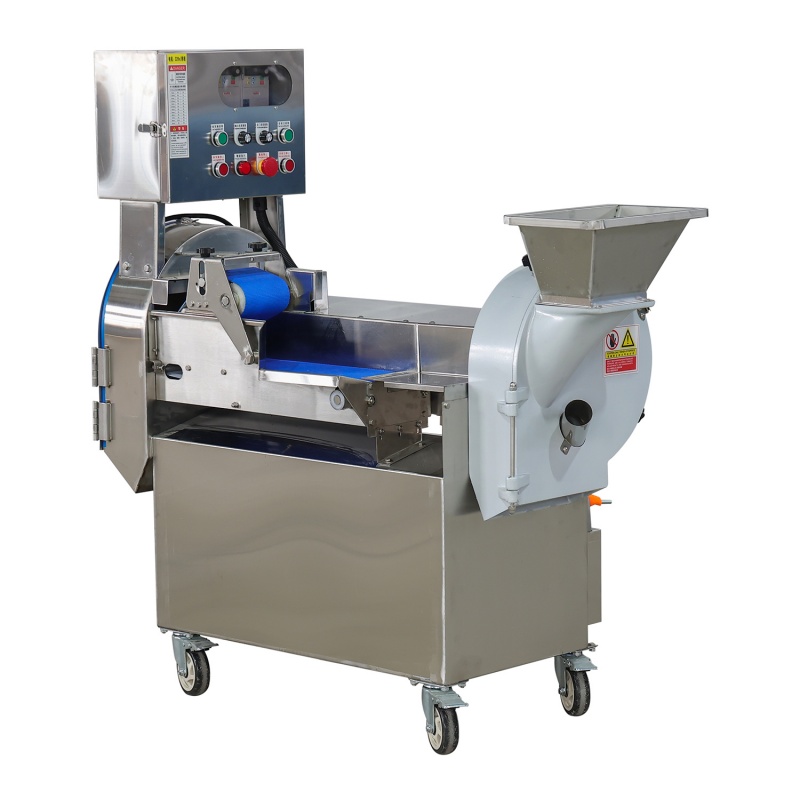
Common Cut Profiles and Processing Metrics
Cut Profile | Primary Application | Critical Success Factor | Common Risk |
|---|---|---|---|
Slicing | Root vegetables, garnishes, chips | Exact thickness uniformity | Fracturing and shattering |
Dicing | Soups, salsas, ready-meals | Clean 3D cube geometry | Excessive fines generation |
Shredding | Slaws, salad kits, blends | Consistent strand length | Moisture weeping/crushing |
Slicing operations are critical for root vegetables and garnishes. Success depends entirely on maintaining exact slice thickness. Uniform slices ensure even frying, baking, or dehydration. An Industrial Vegetable Slicer must handle dense products without fracturing them. Brittle items like potatoes or carrots shatter if the blade speed is incorrect. Shattered pieces burn in fryers and ruin product appearance. Operators must match the blade bevel to the specific vegetable density.
Dicing is essential for soups, salsas, and ready-to-eat meals. Evaluation focuses heavily on achieving clean, three-dimensional cubes. A high-quality Vegetable Dicing Machine executes multiple cuts sequentially. It slices, then uses circular knives, and finally cross-cut knives. The goal is minimizing "fines" during the cross-cut phase. Fines are tiny waste particles. They wash down the drain during rinsing. High fines generation destroys your yield percentage. Clean cuts prevent this unnecessary waste.
Processors use shredding for slaws, salads, and ingredient blends. Success criteria involve consistent strand length. You must also minimize moisture loss during the high-speed shredding process. A Commercial Vegetable Shredder uses centrifugal force or specialized drums. If the blades are dull, the machine crushes the cabbage or carrots. Crushed vegetables weep moisture into the packaging. This creates soggy salads and unhappy consumers. Sharp shredding blades preserve crispness and texture.
You must assess how the machine handles the product before the cut. A premium Commercial Vegetable Cutter utilizes specialized feed mechanisms. Evaluate whether the machine uses continuous belt feeding, gravity hoppers, or alignment tubes. Alignment is crucial for elongated vegetables like cucumbers or carrots. The mechanism must prevent the produce from rolling or shifting. If a carrot rolls just before hitting the blade, you get diagonal, irregular cuts. Top hold-down belts stabilize the product perfectly.
Evaluate the durability of the entire cutting assembly. High-grade stainless steel reduces cellular damage. However, different steel alloys behave differently. Hardened steel holds an edge longer but can be brittle. Softer steel resists chipping but requires frequent sharpening. Specialized bevels reduce the friction against the vegetable. Less friction means less cellular bruising. You must establish strict sharpening protocols. Running dull blades costs more in lost yield than buying new blades.
Inspect blade edges under magnification weekly.
Rotate blade sets to ensure even wear.
Never use abrasive cleaners on sharpened bevels.
Train operators to identify dull-blade bruising immediately.
Precise cuts require perfect synchronization. The blade speed and the feed speed must match exactly. Modern machines feature Variable Frequency Drives (VFDs). VFDs offer tighter control over these variables. Operators can slow down the feed belt for softer items like tomatoes. They can speed it up for dense root vegetables. Without VFDs, you rely on fixed gear ratios. Fixed speeds force you to compromise on cut quality across different produce types.
Vendors often claim massive maximum tonnage per hour. Buyers should ignore these theoretical maximums. Instead, evaluate the usable yield at normal operating speeds. Pushing a machine to its absolute limit usually degrades cut quality. You must factor in the percentage of out-of-spec cuts. A machine processing 5,000 pounds per hour with 10% waste is inferior. A machine processing 4,000 pounds per hour with 2% waste generates more profit. Focus on sustained, high-quality yield.
Operational reality dictates running multiple SKUs daily. Facilities cannot afford hours of downtime between product runs. Evaluate the downtime required to swap cutting assemblies. Moving from a slicing blade to a dicing grid should take minutes. Look for machines featuring tool-less changeovers. Operators should use quick-release clamps and ergonomic handles. If maintenance personnel need wrenches to change a blade, you lose valuable production time. Fast changeovers keep your overall equipment effectiveness (OEE) high.
Food safety is paramount in fresh-cut operations. The machine must meet strict sanitary design standards. Look for IP69K-rated motors and enclosures. These withstand high-pressure, high-temperature washdowns. The frame must feature sloped surfaces. Sloped surfaces prevent water pooling and bacterial growth. Guards should be easily removable for deep cleaning. Poor sanitary design creates harborage points for Listeria and E. coli. A single recall can bankrupt a processing facility. Prioritize hygienic design above all else.
Using high pressure on sensitive bearing seals.
Failing to remove cutting grids during the foaming process.
Leaving standing water in the discharge chute overnight.
Ignoring the underside of the feed belt during inspection.
Moving parts degrade rapidly in wet, acidic environments. Vegetable juices are highly corrosive to standard metals and seals. Evaluate the availability of OEM replacement parts. Ask vendors about their blade sharpening services. Determine your internal maintenance training requirements. Bearings fail frequently if acidic juice breaches the seals. Your maintenance team needs clear schedules for lubrication and inspection. Proactive maintenance prevents catastrophic mid-shift breakdowns. Partner with vendors offering robust technical support.
Never purchase industrial equipment based solely on spec sheets. You must demand rigorous test runs. Conduct a Factory Acceptance Testing (FAT) protocol. Use your specific produce for these tests. Bring vegetables at their typical processing temperature and hardness. Cold carrots cut very differently than room-temperature carrots. Measure the exact yield percentages during the FAT. Inspect the cut edges for bruising. Verify the fines generation rate. If the machine fails the FAT, walk away.
Establish a cross-functional buying committee immediately. Include representatives from Operations, Quality Assurance (QA), and Maintenance. Operations will evaluate throughput and ease of use. QA will inspect cut quality and sanitary design. Maintenance will assess part accessibility and durability. Audit equipment demonstrations together. Review the vendor's service level agreements (SLAs) carefully. Ensure they guarantee fast response times for spare parts. A unified committee makes smarter, more resilient purchasing decisions.
Precision cutting serves as the absolute linchpin of profitability in vegetable processing. Variations cost money at every single downstream stage. Irregular cuts ruin thermal processing, jam packaging lines, and accelerate spoilage. You cannot afford to treat cut size as an afterthought. It dictates your yield, your quality, and your reputation.
Invest in equipment prioritizing exact tolerances and sanitary design over sheer speed. Form a cross-functional team to evaluate machinery using your actual produce. Demand tool-less changeovers and IP69K washdown compliance. By focusing on sustained yield and cellular integrity, you ensure long-term reliability. This strategic approach guarantees compliance and profitability in a demanding plant environment.
A: It depends heavily on produce density and throughput. Root vegetables may require weekly blade swaps or sharpening. Softer produce extends the blade lifespan significantly. Establish a strict monitoring schedule. Inspect edges under magnification to prevent yield loss before it starts.
A: Yes, provided the machine features variable speed controls. It must also have interchangeable cutting harps and grids. Operators adjust the feed speed and blade velocity to accommodate different cellular structures without crushing the product.
A: A precise, sharp cut cleanly severs plant cells rather than crushing them. This minimizes oxidative browning and cellular weeping. Keeping the cell walls intact prevents bacterial growth, which extends the overall shelf-life significantly.


